
The Ongoing Conversation of Consent

Consent is not a box to tick or a one-time yes before a sexual encounter. It is an ongoing conversation about desire, boundaries, comfort, and safety.
Many of us were never taught the nuances of consent, which can leave people with the idea that once you have agreed to something, that is it. But our feelings, energy, and needs shift, sometimes from moment to moment. Healthy intimacy grows when we check in, with ourselves and with each other.
Consent isn’t something you give once, it’s something you give, check and revisit again and again.
Why Talking About Consent Matters
Consent is much more than a formality. It is a fundamental part of safety, respect, and mutual trust.
In the UK, one in five women and one in twenty men experience some form of sexual assault in their lifetime. Only around 15 to 20 percent of these cases are reported to the police, meaning the real numbers are likely higher.
Sexual assault can happen in any relationship, at any age, and to people of all genders and sexualities.
Talking openly about consent gives people language to recognise safe and wanted contact, identify behaviour that feels uncomfortable or unsafe, and communicate boundaries clearly and confidently.
Consent is more than words. It’s about recognising safety, respect and mutual understanding.
What Consent Actually Is
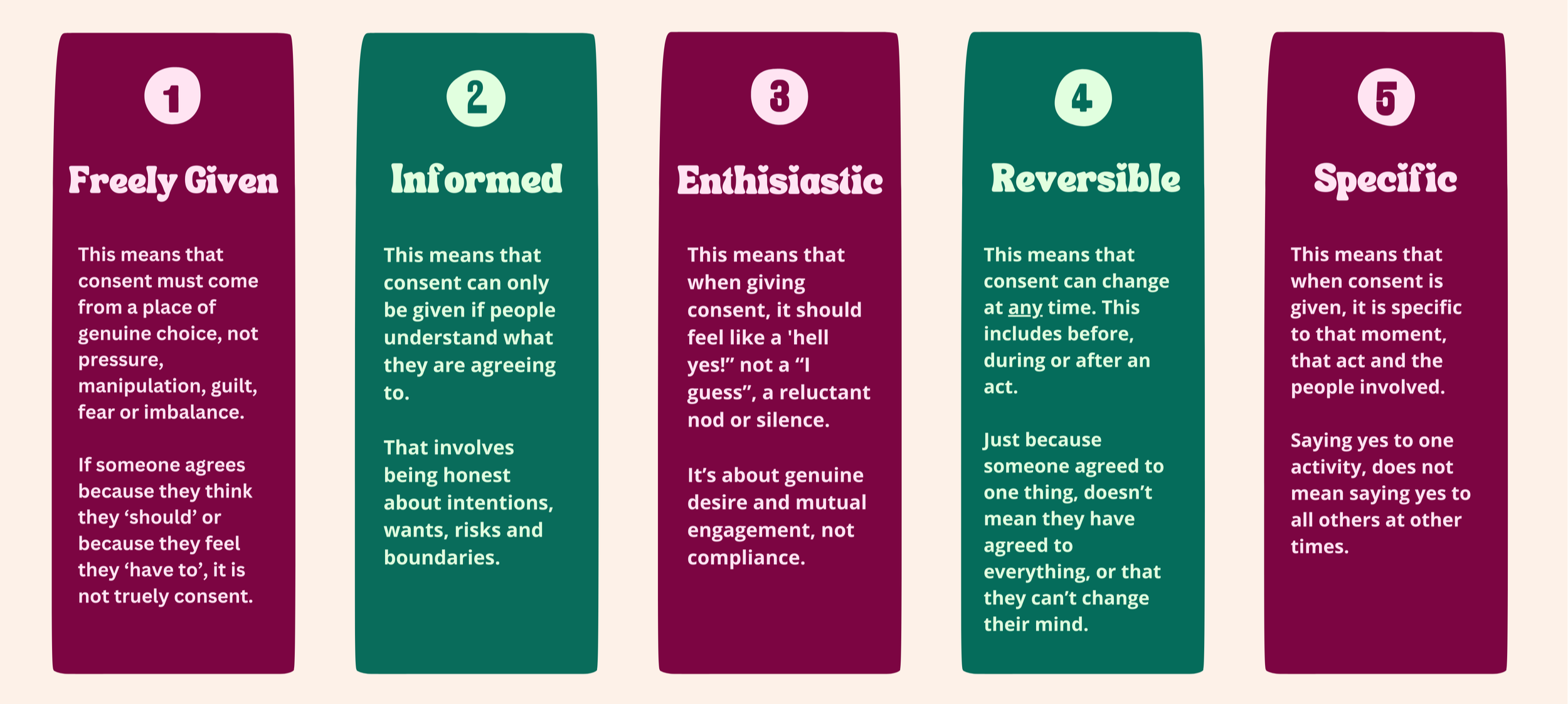
Consent means freely agreeing to something. A widely used framework, known as the FRIES model, breaks this down into five principles:
Consent in Practice is Not Always Simple
Even when we understand consent intellectually, it can feel complicated in real life. Behaviours can be subtle: a pause, a glance, a shift in tone.
Cultural messages, past trauma, power dynamics, or fear of rejection can all affect how safe it feels to speak up. That is why consent is not a single exchange; it is a continuous process of noticing, checking in, and adapting.
Boundaries Are Always Changing
Comfort, energy, and desire fluctuate because we are human.
Physical health, mental health, hormonal shifts, and life circumstances can all influence how we feel from one day to the next, or even within a single encounter.
Healthy intimacy grows when those shifts are noticed, acknowledged, and respected.
Consent can change from one moment to the next. Checking in matters.
Communication isn’t a Performance
You do not need the perfect words. Conversations about consent will sometimes be clear and sometimes feel awkward or clumsy, and that is okay. What matters is awareness, care, and a willingness to pause when something feels uncertain.
That means checking in when you notice hesitation, paying attention to non-verbal signals, slowing down when needed, and reflecting on your own comfort too.
Simple questions go a long way:
"Does this feel okay?"
"Would you like to keep going?"
"Do you want to slow down?"
Consent is Active, Not Passive
Being in a relationship, or having agreed to something before, does not mean automatic consent going forward. It is normal and kind to keep checking in. Intimacy is not a checklist or a race toward a specific outcome.
There is no requirement to reach penetration, orgasm, or any other goal. It can simply be about connection, closeness, and presence, being attuned to what feels good and respecting when something does not.
Your boundaries matter as much as anyone else's. It is always worth asking yourself:
“Am I comfortable right now?”
“Do I actually want this?”
“Do I feel safe?”
If you’ve had harmful or unsafe experiences
If you have experienced sexual activity that left you scared, violated, or unable to say no, it was not your fault. Whether it involved a stranger, a date, a friend, or a partner, you deserve to be believed and supported. Your experience is valid even if you did not fight back or say no, even if you had been drinking, and even if you cannot remember everything clearly.
If you’re in immediate danger: Call 999.
If you are safe but need support, the following services are available:
Rape Crisis England and Wales: 0808 500 2222, freephone and available 24 hours a day, seven days a week. Visit rapecrisis.org.uk
Survivors UK, for men, boys, and non-binary people: text 020 3322 1860 or visit survivorsuk.org
Galop, for LGBTQ+ survivors: 0800 999 5428 or visit galop.org.uk
You can also find your nearest Sexual Assault Referral Centre at nhs.uk
It is your right to decide whether to report what happened. Support services can guide you through your options whenever, and if, you feel ready.
It’s your right to decide whether to report what happened.
Support services can guide you through options when , and if , you’re ready.
Why Sex Actually Exists
Sex Actually exists because too many people have been left out of sex education, or taught only narrow versions of what intimacy and consent should look like.
Our aim is to offer inclusive, evidence-informed education that supports real experiences, real bodies, and real relationships. We are here to make conversations about sex, relationships, and wellbeing accessible, shame-free, and relevant for everyone, so you can understand yourself and others with greater confidence, curiosity, and care.
If this article sparked reflection or curiosity, you might like to explore more of our writing on communication, boundaries, pleasure, faith, and identity.